The Best Contact Lenses for the Over 40s
Expert advice on understanding presbyopia and choosing contact lenses for clear, comfortable vision after 40.
Reviewed by John Dreyer BSc (Hons), DipCL – Optometrist & Clinical Content Reviewer

If menus, messages and other small print are becoming harder to read, you are not alone. From around the age of 40, the eye gradually becomes less able to change focus between distant and nearby objects. This normal age-related change is known as Presbyopia does not mean you have to stop wearing contact lenses or automatically rely on reading glasses. Modern multifocal contact lenses can help provide clear vision at near, intermediate and distance, allowing many people to continue working, driving, reading and enjoying an active lifestyle without giving up the the need for reading glasses.
This guide explains why vision changes after 40, the different ways presbyopia can be corrected and how to choose the best contact lens option that suits your eyes, lifestyle and visual needs.
Our Optometrist’s Advice
Reaching your 40s does not mean giving up contact lenses. It usually means your visual needs are changing and your contact lens prescription may need to change with them.
Modern multifocal lenses work very well for many people, but fitting them can be more individual than fitting a standard distance lens. Small adjustments to the distance or near prescription can make a noticeable difference.
The aim is to find the best balance for the tasks that matter most to you — whether that is driving, computer work, reading, sport or a combination of all four.
Our Best Recommended Contact Lenses for the Over 40s
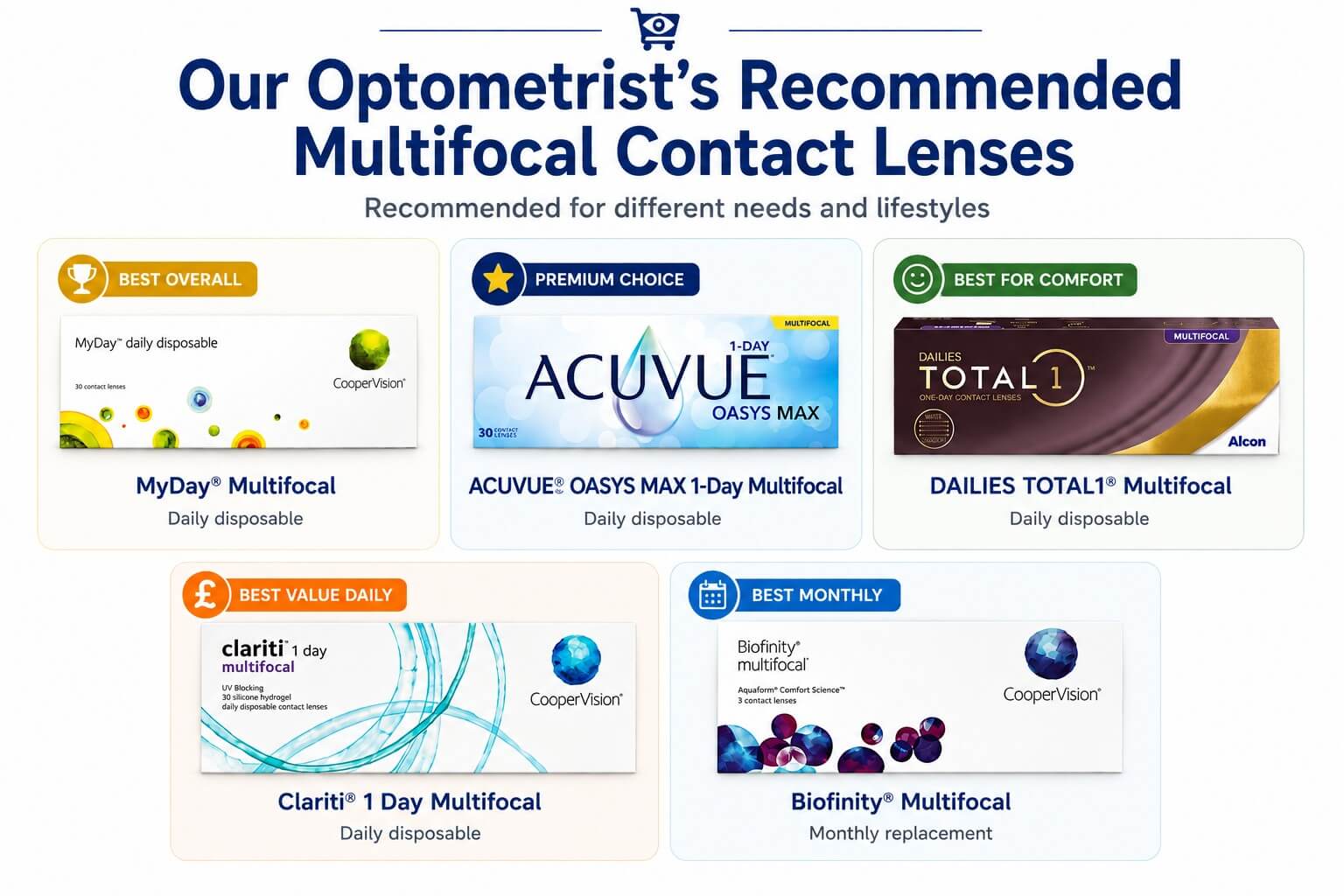
There is a wide choice of multifocal contact lenses available today. These are some of the options we think deserve particular consideration for different types of wearer.
| Best For | Contact Lens | Replacement | Material | Why We Chose It |
|---|---|---|---|---|
| Best Overall | MyDay Multifocal | Daily | Silicone hydrogel | A strong all-round choice combining the convenience of a daily disposable with a breathable silicone hydrogel material and a multifocal design intended to provide clear vision at different distances. |
| Premium Choice | ACUVUE OASYS MAX 1-Day Multifocal | Daily | Silicone hydrogel | A premium daily multifocal option designed for modern visual demands, with technology aimed at maintaining moisture and supporting clear vision across different distances and lighting conditions. |
| Best for Comfort | DAILIES TOTAL1 Multifocal | Daily | Silicone hydrogel | Its water-gradient surface and high oxygen transmission make it a strong option for wearers who place a particularly high priority on comfort throughout the day. |
| Best Value Daily | Clariti 1 Day Multifocal | Daily | Silicone hydrogel | Offers daily disposable convenience, silicone hydrogel material and multifocal correction at a comparatively accessible price. |
| Best Monthly | Biofinity Multifocal | Monthly | Silicone hydrogel | A breathable monthly multifocal that provides a good balance of vision, comfort and value for regular wearers who are happy to clean and store their lenses. |
A note about our recommendations
The most advanced or expensive lens is not automatically the best lens for every eye.
Your prescription, tear film, pupil size, lens movement and the balance you need between distance and near vision can all affect how well a multifocal contact lens performs.
It's important to be professionally fitted with multifocal contact lenses to ensure the best vision, comfort and wearability, and we advise that you continue ordering the exact lens and prescription approved by your optometrist.
Ready to find the right multifocal contact lenses?
Explore our range of multifocal contact lenses, including the options recommended in this guide.
N.B. These recommendations are intended as a guide. Your optometrist may recommend a different contact lens depending on your prescription, eye health and lifestyle.
Why Does Near Vision Change After 40?
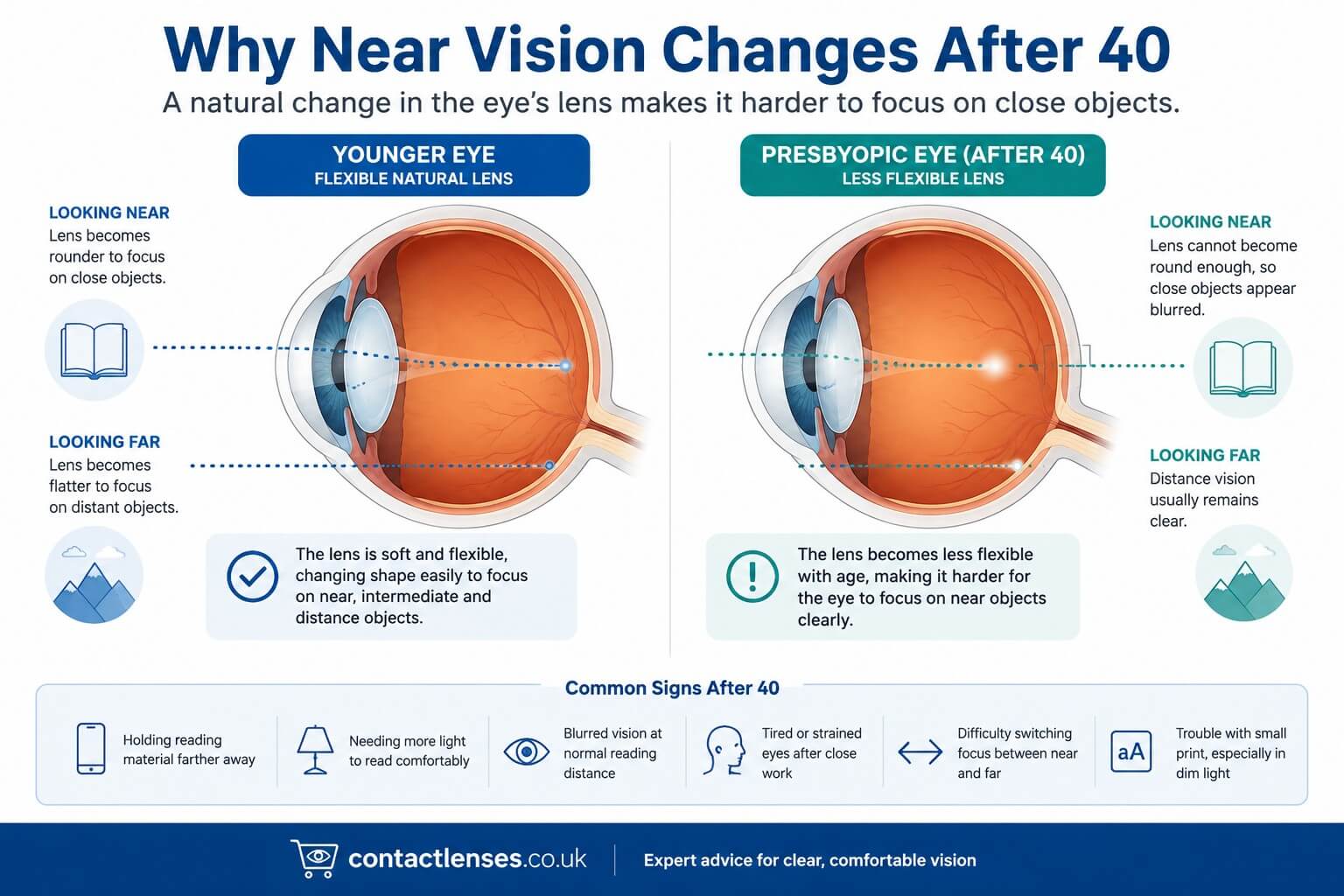
Presbyopia is the gradual loss of the eye’s ability to focus clearly on nearby objects.
When we are younger, the natural lens inside the eye is flexible enough to change shape easily. This allows the eye to switch focus from something in the distance to something close by or vise versa.
As we get older, our natural lens becomes less flexible. Focusing at close range becomes progressively more difficult even though distance vision may still remain clear.
Common signs of presbyopia include:
- Holding a phone, book or menu farther away to focus clearly
- Needing brighter light to read comfortably
- Blurred vision at normal reading distance
- Tired or strained eyes after close work
- Difficulty switching focus between near and distant objects
- Finding small print particularly difficult in dim light
Presbyopia is a normal part of ageing rather than an eye disease.
However, changes in vision should still be assessed during a regular eye examination,
particularly if they appear suddenly, affect only one eye or are accompanied by other
symptoms.
Your Options for Correcting Presbyopia
Reading glasses are often associated with reaching your 40s, but they are not the only way to correct presbyopia.
There are several effective options. The right one depends on your prescription, lifestyle, visual priorities and personal preference.
| Option | Best For | Things to Consider |
|---|---|---|
| Reading Glasses | Occasional close work | Simple and convenient if you only need help with near vision, but they need to be put on and removed whenever required. |
| Bifocal or Progressive Glasses | People who prefer spectacle correction throughout the day | Can correct both near and distance vision in one pair of glasses. Progressive lenses provide a gradual change in power without the visible dividing line found in traditional bifocals. |
| Multifocal Contact Lenses | People who want near, intermediate and distance correction without relying on glasses | Provide several focusing powers within the contact lens and can be particularly useful for active lifestyles without the need for glasses. |
| Monovision | Effective for some contact lens wearers | One eye is primarily corrected for distance and the other for near. It can work extremely well for some people but requires an adaptation period. |
| Refractive Surgery | Suitable for people who want to reduce their dependence on glasses or contact lenses | Requires specialist assessment and is not appropriate for everyone. Treatment is normally undertaken privately. |
The remainder of this guide focuses primarily on contact lenses because they provide one of the most flexible ways of correcting presbyopia while retaining the freedom many wearers value.
Can Contact Lenses Correct Presbyopia?
Absolutely.
There are several ways of correcting presbyopia with contact lenses, depending on your lifestyle, prescription and how much near-vision assistance you need.
For many people, the first option considered will be multifocal contact lenses.
These contain more than one corrective power within the lens and are designed to provide useful vision across near, intermediate and distance ranges.
Multifocal contact lenses are available as:
- Daily disposable lenses
- Two weekly disposable lenses
- Monthly disposable lenses
- Hydrogel lenses
- Silicone hydrogel lenses
They can also correct short-sightedness or long-sightedness alongside presbyopia.
Some people with astigmatism may be suitable for specialist multifocal toric lenses, although fewer designs are available and fitting may be more complex.
How Do Multifocal Contact Lenses Work
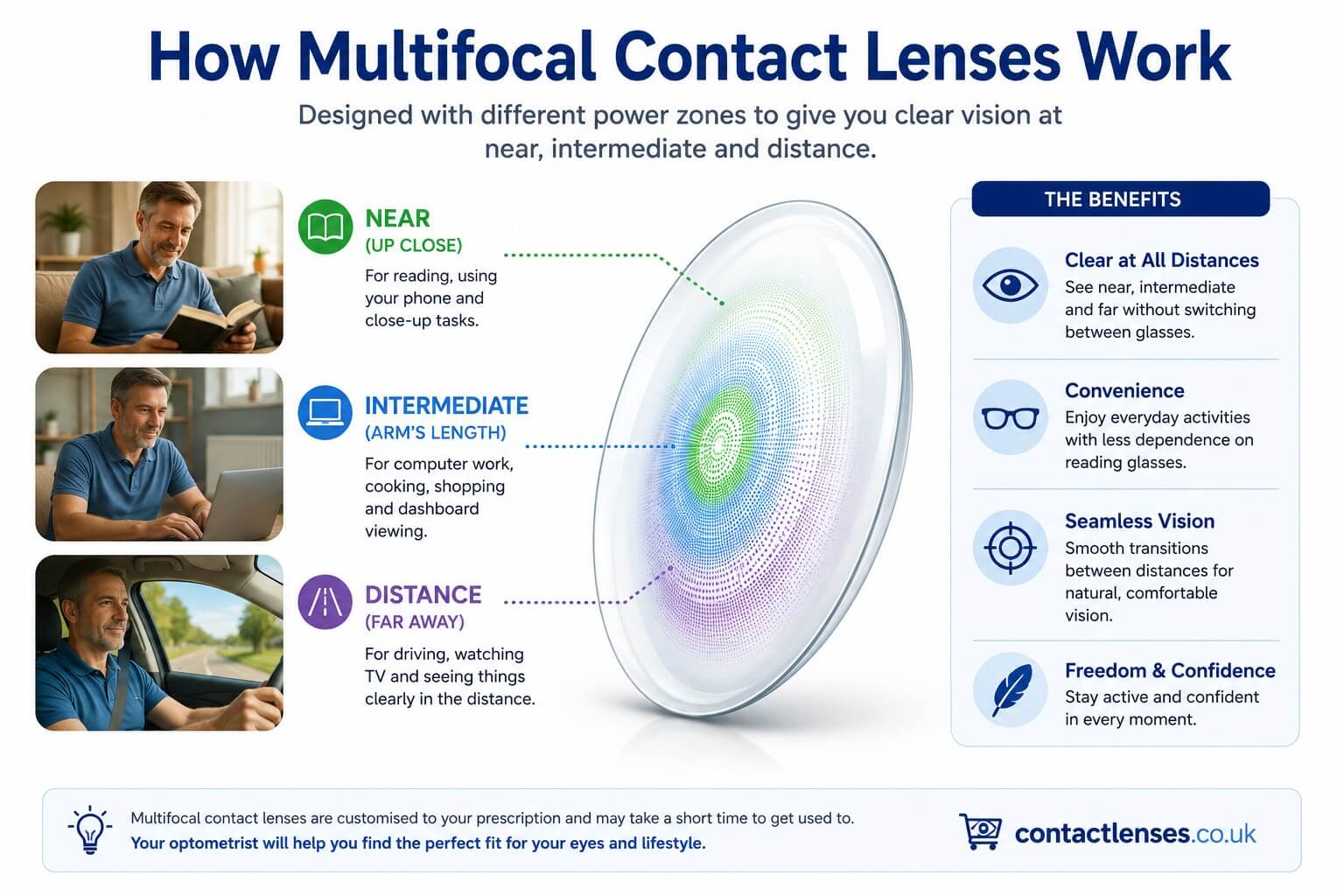
Multifocal contact lenses contain different focusing powers within the same lens.
Unlike progressive spectacle lenses, where you look through a particular part of the lens for different distances, many multifocal contact lenses use a principle known as simultaneous vision.
This means information for near and distance vision reaches the eye at the same time. Your visual system gradually learns to concentrate on the image needed for the task in front of you.
In everyday life:
- Near vision is needed for reading a message, book or menu.
- Intermediate vision is important for laptops, dashboards and many workplace tasks.
- Distance vision is required for driving, television and recognising objects farther away.
Different manufacturers arrange their optical zones differently. Some designs are centre-near, while others use different combinations of near and distance power.
Your optometrist will take your prescription, visual priorities and how the lens performs on your eye into account when deciding which lens is best for you.
Are Multifocal Contact Lenses the same as Varifocal Glasses
No.
Progressive or varifocal spectacle lenses provide different powers depending on which
part of the lens you look through.
A contact lens moves with your eye, so multifocal contact lenses generally work differently.
This is one reason why wearing multifocal contact lenses can feel different from wearing progressive glasses, and why a period of adaptation may sometimes be needed.
Alternatives to Multifocal Contact Lenses
Multifocal contact lenses are an important option, but they are not the only contact lens approach to presbyopia.
Monovision
With monovision, one eye is corrected mainly for distance vision and the other mainly for near vision.
The brain gradually learns to select whichever eye provides the clearest image for the task being performed.
Some people adapt extremely well.
Others may notice reduced depth perception or feel that the quality of their vision is not as balanced as it is with both eyes working together at the same distance.
Modified Monovision
Modified monovision combines elements of monovision and multifocal correction.
For example, one eye may wear a lens primarily corrected for distance while the other wears a multifocal lens providing additional support for near tasks.
This can sometimes provide a useful alternative when standard multifocal correction does not give the desired balance.
Distance Contact Lenses with Reading Glasses
There is also nothing wrong with continuing to wear distance contact lenses and using reading glasses when required.
This may suit someone who only occasionally needs help with close work or who performs prolonged, particularly detailed near tasks.
The disadvantage is obvious: you still need to carry reading glasses, which may be exactly what you hoped to avoid by wearing contact lenses.
A Contact Lens in one eye
Someone who has naturally good distance vision and only requires help with close work may sometimes be suitable for a single contact lens correcting the near vision in one eye.
This is another form of monovision and should always be trialed and assessed professionally.
Adapting to Multifocal Contact Lenses
Some people find multifocal contact lenses comfortable and visually useful almost immediately.
Others need several days or sometimes longer for their visual system to adapt.
During the early stages you may notice:
- One distance appearing clearer than another
- Fluctuating clarity
- More difficulty in dim lighting
- Halos or glare
- Extra effort when reading very small print
This does not automatically mean that the lenses have failed.
Don't give up. Multifocal contact lens fitting is often a process rather than a single appointment. A small adjustment to the distance prescription, near addition or balance between the eyes can make a noticeable difference.
What can improve your chance of success?
- Wear trial lenses according to your optometrist’s instructions.
- Test them during your normal day rather than judging them only in the consulting room.
- Notice whether any difficulty is mainly at near, intermediate or distance.
- Give your visual system a reasonable opportunity to adapt.
- Attend the recommended follow-up appointment(s).
- Tell your optometrist which everyday activities matter most to you.
Saying “My computer vision is good, but road signs are less clear at night” is much more useful than simply saying “I can't see clearly.”
Choosing Daily or Monthly Disposable Multifocal Lenses
Both daily and monthly disposable multifocal lenses can provide successful vision correction.
The right wearing schedule will depend on how frequently you wear your lenses, how much maintenance you want undertake and which particular design gives you the best vision and fit.
Daily Multifocal Lenses may suit you if:
- You want a fresh lens every day
- You prefer not to clean or store lenses
- You only wear contact lenses occasionally
- You travel regularly
- Convenience is particularly important to you
- Your optometrist recommends a daily replacement schedule for your eyes
Monthly Multifocal Lenses may suit you if:
- You wear contact lenses most days
- You are comfortable following a cleaning routine
- A particular reusable lens gives you your best vision or fit
- You prefer the economics of a longer replacement schedule
- Your prescription is better served by a monthly design
The wearing schedule should therefore be treated as part of the decision rather than the decision itself.
The best multifocal lens is ultimately the one that fits well, provides useful vision and suits a routine you can follow consistently.
Can You Wear Multifocal Lenses If You Have Dry Eyes?
Almost certainly.
However, if contact lenses are making your eyes feel dry or uncomfortable, it is better to identify the cause rather than assuming that changing to a particular material will automatically solve the problem.
Dryness during lens wear can be influenced by:
- Reduced blinking during screen use
- Air conditioning or central heating
- How many hours the lenses are worn
- Tear-film quality
- Certain medicines
- Eyelid or ocular-surface conditions
- Lens material
- Lens fit
- Replacement schedule
Some modern multifocal lenses use materials and surface technologies designed to support moisture and comfort, but individual experiences still vary.
Persistent dryness, redness or irritation should be discussed with your optometrist.
Changing lenses without understanding the cause may simply move the problem rather than solve it.
Contact Lenses or Glasses After 40?
Neither is universally better.
Many people over 40 use both depending on what they are doing.
Contact lenses offer:
- Unrestricted peripheral vision
- Freedom from spectacle frames
- No misting or rain on lenses
- Convenience for sport and active lifestyles
- A natural appearance
- Less need to repeatedly put reading glasses on and take them off
Glasses offer:
- Simple vision correction
- No contact lens insertion or removal
- A useful alternative when you want a break from lens wear
- Strong near correction for prolonged detailed tasks
- An option when contact lenses are unsuitable
A combination can often be the most practical solution.
You might wear multifocal contact lenses for work, social occasions and active days, while keeping glasses for certain close tasks, evenings or whenever you simply prefer them.
Using both does not mean the contact lenses have failed.It means you are using the form of vision correction that works best for the situation.

Buying Multifocal Lenses With Your Prescription
Multifocal contact lenses need to be professionally fitted.
A spectacle prescription cannot simply be converted into a multifocal contact lens order.
Your contact lens fitting will need to establish:
- Contact lens power
- Reading addition
- Lens design
- Base curve and diameter
- The balance between distance and near vision
- How the lens behaves on your eye
- Whether a particular design suits your everyday visual requirements
Different multifocal brands use different designs.
That means two products carrying apparently similar prescription powers may not provide the same vision or fit.
Once you have been successfully fitted, you should continue buying the exact contact lens and prescription approved by your optometrist unless they recommend a change.
Common Questions About Contact Lenses After 40
Can I start wearing contact lenses after 40?
Yes.
You do not have to be an existing contact lens wearer. Many people first try contact lenses in their 40s, 50s or later.
You will need an eye examination and contact lens fitting to determine whether your eyes are suitable and which method of correction is most appropriate.
Do I need multifocal contact lenses as soon as I turn 40?
No.
Presbyopia develops gradually and does not begin on your 40th birthday.
Some people notice changes earlier than others, and initially you may only experience difficulty with very small print, prolonged close work or reading in poor light.
Your optometrist can advise when a change in correction becomes useful.
Are multifocal and varifocal contact lenses the same?
The terms are sometimes used interchangeably.
Multifocal is now the more commonly used term for contact lenses containing more than one corrective power, whereas varifocal is more frequently associated with progressive spectacle lenses.
Will multifocal contact lenses completely replace reading glasses?
They may do for many everyday activities.
However, some people still find additional reading glasses useful for prolonged or very detailed close work.
The goal of a multifocal fitting is normally to provide the most useful balance across the distances that matter to you.
Can multifocal contact lenses correct astigmatism?
There are specialist contact lenses that combine multifocal and toric correction.
The choice is more limited than it is for straightforward presbyopia, and fitting can be more complex.
Your optometrist can advise which options are suitable for your prescription.
Are daily multifocal lenses better than monthly multifocals?
Not automatically.
Daily lenses provide convenience and require no cleaning, while monthly lenses may provide better value for frequent wearers and sometimes offer a particular design or prescription that better suits the wearer.
Fit and visual performance are more important than replacement schedule alone.
Why is my distance vision blurred in multifocal contact lenses?
Your visual system may still be adapting, or the balance between distance and near correction may need adjusting.
Lighting, pupil size and the optical design of the lens can also affect vision.
Persistent blur should be discussed at your contact lens follow-up rather than corrected by changing the prescription yourself.
Why can I read in daylight but struggle in a dim restaurant?
Near-vision difficulties associated with presbyopia are often more noticeable in poor lighting.
Small print can therefore be easier to read in bright, well-directed light than in a dim restaurant or bar.
How long should I try multifocal contact lenses before deciding?
Follow the trial period recommended by your optometrist.
Some people adapt quickly, while others need more time or benefit from a small prescription adjustment.
Pain, marked redness, sudden loss of vision or significant discomfort should not be regarded as normal adaptation. Remove your lenses and seek professional advice.
Can I order a different multifocal brand with the same prescription powers?
Not without professional approval.
Multifocal brands use different materials, fits and optical designs. Matching the numbers on the prescription does not necessarily mean another lens will behave in the same way.
Helpful Guides
The Bottom Line
Getting older does not mean giving up the freedom of contact lenses.
Presbyopia is a normal change in the way your eyes focus, and there are now several effective ways of managing it.
For many people, multifocal contact lenses provide a practical balance of near, intermediate and distance vision while allowing them to continue working, driving, exercising and enjoying everyday life without relying on reading glasses.
The important thing is finding the solution that works for your eyes and the way you live.
Ready to find the right multifocal contact lenses?
Explore our range of multifocal contact lenses, including the options recommended in this guide.